

- AI Strategy
- Enterprise AI
- AI Infrastructure
What We Learned at the AI+ Expo: A Global Look at Where AI Actually Stands in 2026
Three days, more than 20,000 people, and one settled question. Not whether AI matters, but what to do with it, and what happens to the organizations that get it wrong. What we heard, in plain language.
John Macchione, Co-Founder, AtomDigit · June 30, 2026 · ~13 minutes

Earlier this quarter, we attended the SCSP AI+ Expo in Washington, DC. Over three days, more than 20,000 people filled the Walter E. Washington Convention Center: government officials, military commanders, researchers, engineers, entrepreneurs, and executives from nearly every sector imaginable, and from countries across the globe.
The Special Competitive Studies Project (SCSP), which hosts the event, describes its mission as strengthening long-term competitiveness in AI and emerging technology. The sessions reflected that mandate, covering everything from national defense and cybersecurity to biological research, energy infrastructure, quantum computing, semiconductor supply chains, cognitive warfare, the future of small business, and much more in between.
This was not a conference about whether AI matters. That question has been settled. This was a conference about what to do with it, and what happens to countries, industries, and organizations that get it wrong.
While it was impossible to take in everything across three days, we were able to capture a significant portion of the conversation. What follows reflects what we heard, translated into plain language for anyone trying to make sense of AI regardless of their technical background or industry.
The Gap Between Experimenting and Executing
The most persistent theme at the conference had nothing to do with model capabilities or research breakthroughs. It was about the difficulty of turning AI investments into operational reality.
Cameron Stanley, the Chief Digital and AI Officer at the United States Department of War, described exactly how this played out in defense. Starting in 2016 with Project Maven, the military built sophisticated AI to analyze drone footage from Iraq and Afghanistan. The algorithms worked. The problem was what happened next.
“We were inserting AI into a workflow that was broken. Even with multi-million dollar algorithms to push data in seconds, we still had everything bottlenecked by human beings trying to make decisions based on our processes.”
The lesson that changed everything was to stop focusing on the AI and start focusing on the decisions. The shift from AI-centric to decision-centric development, embedding engineers directly alongside warfighters to understand what they actually needed, transformed Project Maven into what Stanley described as "the best AI-enabled command and control capability on the planet." Operation Epic Fury, conducted earlier this year, processed 13,000 targets across 38 days using that system.
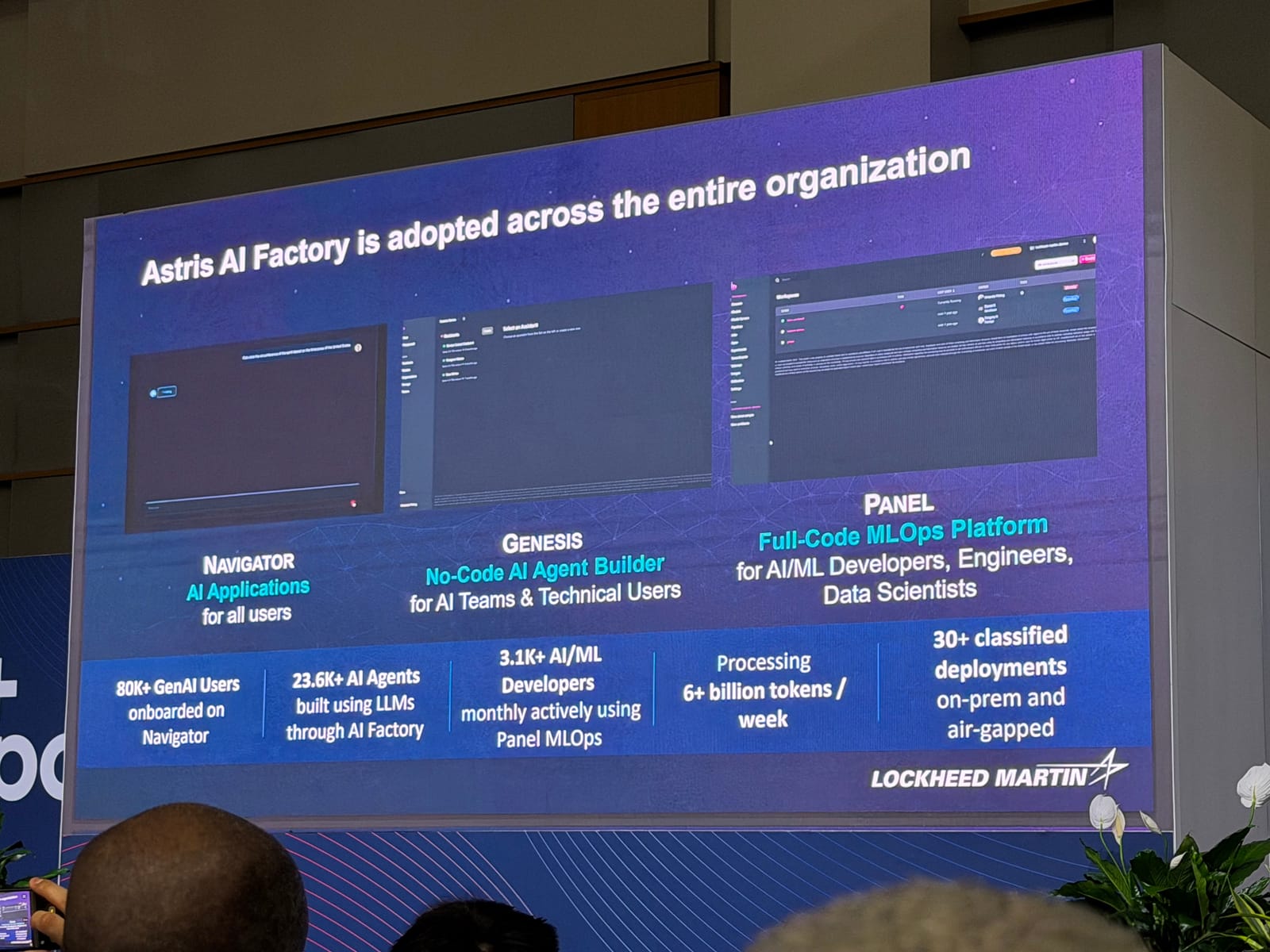
The same gap shows up far outside defense. Bill Briggs, Deputy Administrator of the U.S. Small Business Administration, described visiting a manufacturing firm in Omaha, Nebraska that had figured this out. Rather than deploying AI as a standalone tool, the company gave employees 15 minutes each morning to think about how they could do their jobs better, then used AI to synthesize those ideas and surface performance gaps. The result was a company on track to double its facility size and employee count within two years. "AI is a force multiplier for that small business," Briggs said. The difference between that company and the many that have not yet figured it out is not the technology. It is the workflow built around it.
AI Is Now Official Policy, Globally

One of the clearest signals from the conference was that AI adoption has moved from organizational choice to institutional mandate, and not just in the United States.
Cameron Stanley, the CDAO, was direct about the direction of US policy: "We are a commercial-first organization. Commercial tech is the best in the world, especially US commercial tech." GenAI.mil, the Department of War's generative AI platform, has passed one million unique users, and more than 100,000 customized agents are now running inside department environments. The Department of War recently signed agreements with eight of the world's leading AI companies, including OpenAI, Google, NVIDIA, Microsoft, and AWS (Amazon Web Services), to expand AI access across classified networks. His clearest statement of the stakes:
“The most dangerous course of action right now is to stand still and remain in a human-driven world.”
Internationally, the picture is equally striking. Bastian Giegerich, Director-General of the International Institute for Strategic Studies (IISS), presented data showing European defense spending reached $560 billion in 2025, a 12.6 percent real-term increase that now accounts for 21 percent of global total. The pressure behind that spending is not just about weapons and equipment. It is about building the AI and digital infrastructure needed to deploy them effectively.
Charles Forte, Chief Information Officer of the UK Ministry of Defence, described what that looks like in practice. The UK has built what it calls a "digital backbone," designed to connect any effector to any sensor through any decision maker, in real time, end to end across the system, where any of those three elements can be either a person or a piece of technology. "The world is software defined," Forte said. "To compete and engage successfully in the modern world, it is about how you bring the integration of your forces together in a way that's defined by software and data." His broader point applied well beyond defense: organizations that treat AI as incremental improvement to existing structures will fall behind those that redesign around it from the ground up.
Dr. Anshuman Roy, founder and CEO of Rhombus Power Inc., whose systems are used by Taiwan, Japan, India, and other allies for predictive intelligence, put the organizational challenge plainly:
“Our institutions are structured very much like they were in the 20th century. You're imposing a lot of technology onto that structure, hoping that effectiveness goes up for the entire enterprise, and it does to some extent. But it would be dramatically different if we were to restructure by thinking from an AI-native perspective.”
Why Compliance Is No Longer Optional
For organizations that work with sensitive data, whether government contractors, financial firms, healthcare organizations, or universities, AI introduces a new layer of regulatory complexity that most are not yet prepared for.
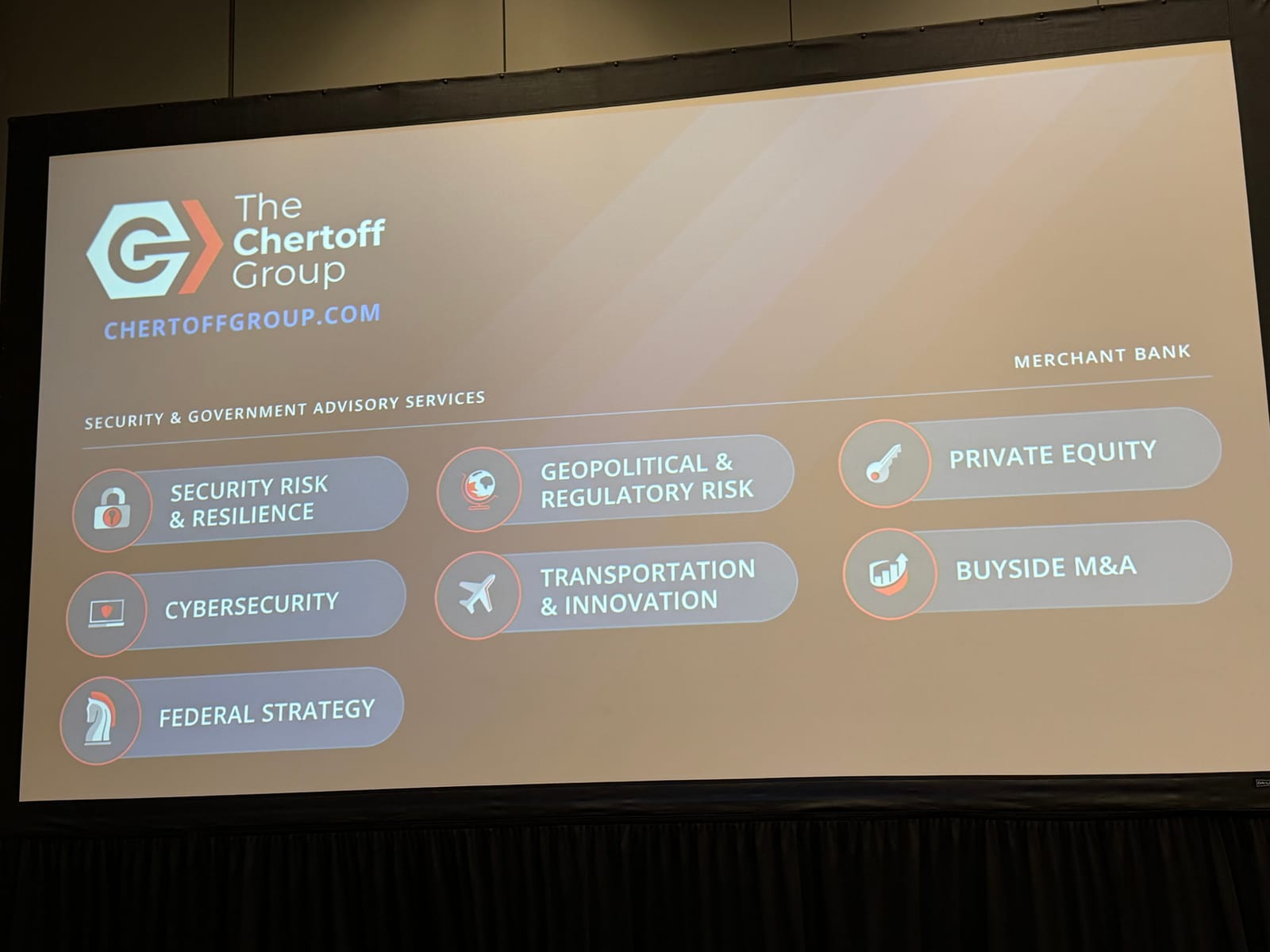
The Chertoff Group convened a panel on building defensible AI security programs, and the picture they painted was sobering. John Steven, founder of Aedify Security, put it directly: "There is no secure software development lifecycle equivalent as an AI secure software development lifecycle right now." The volume of code being written and deployed is expected to rise 16-fold in 2026, driven largely by AI-assisted development. As AI tools write more code more quickly, the attack surface expands faster than security teams can monitor it, and organizations are deploying AI into production without the governance frameworks, audit trails, or accountability structures that regulators will eventually require.
Adam Isles, Head of Cybersecurity Practice at the Chertoff Group, described a pattern he is seeing repeatedly: "In three of the four firms I'm working closely with, the Chief Information Security Officer's organization has been left out, and there is a new fast lane for development, because security says no and takes too much time." The result is an accountability gap where AI systems are being deployed without clear ownership of what happens when they fail.
Daniel Sutherland, who led Meta's cybersecurity legal team and helped launch the Cybersecurity and Infrastructure Security Agency (CISA), framed the solution as developing what he called "fast GRC," meaning governance, risk, and compliance processes that move at the speed of software rather than the speed of legal review. "You have to develop them in advance," Sutherland said, "and then you can automate them." For any organization operating in a regulated environment, the window to build these foundations before they become a compliance liability is open. It will not stay open.
The Data Problem Nobody Talks About Enough
Across every sector represented at the conference, from research institutions and defense agencies to financial services and higher education, one theme surfaced consistently that had nothing to do with AI models at all. It was about data.
Most organizations are sitting on enormous amounts of valuable information that is scattered across different systems, stored inconsistently, and not accessible to the people who need it. Different departments use different tools. Data collected years ago does not connect to data collected today. Institutional knowledge lives in email threads and the heads of experienced employees rather than in systems that can be searched and used.
Veronica Daigle, President of National Security Practice at Red Cell Partners, named this directly:
“Data is so disaggregated in many cases and hard to pull together. Sometimes I worry that with the AI applications we're building, it may just be putting almost a band-aid over the underlying issues with the data.”
Her prescription was to step back before layering AI onto existing workflows and ask whether those workflows are actually producing the right outcomes. "We should be thinking about what's the outcome we're trying to achieve, and are there alternative ways to go after that?"
The organizations making the most meaningful progress with AI are not necessarily the ones with the most sophisticated models. They are the ones that invested in getting their information organized and accessible before trying to build on top of it.
The Global Race and What It Means for Everyone
The conference made clear that AI development is not a domestic story. It is a global competition with real consequences for every organization in every industry.
Jason Droege, CEO of Scale AI, put it plainly: "I have been shocked at how much access, and at what levels in government, AI is being discussed as a strategic imperative for the country. It is the heads of state for probably every country in the world. And that's why you're getting this, do we have to work differently?"
Scale AI is building AI infrastructure for governments including Qatar, the UK, and others across the Middle East, not just for defense but for core services including education and healthcare. Droege described the philosophy behind this work as building from the ground up rather than retrofitting existing systems: "We're actually building things like education and certain healthcare systems and core infrastructure from the ground up, taking AI as a starting point for how would those functions inside of a country work if you did not have to necessarily retrofit an existing system." That framing, AI-first by design rather than AI retrofitted onto legacy structures, was the dividing line that came up repeatedly throughout the conference.
It was not only large nations wrestling with this. Tamsin Deasey-Weinstein, Chair of the AI and Intelligence strand of the Cayman Islands Digital Transformation Task Force, offered a perspective that illustrated how universal the challenge is. The Cayman Islands, where financial services represent 55 percent of GDP, faces a set of AI opportunities and constraints specific to a small island nation, including digital literacy and AI skill development for its citizens, the opportunity to use AI to improve government processes such as immigration and disaster response, and the practical challenge of building data center infrastructure with limited physical space for expansion. The questions she is navigating are the same ones facing governments ten times the size. How do you build for AI-first when the foundation was never designed for it?
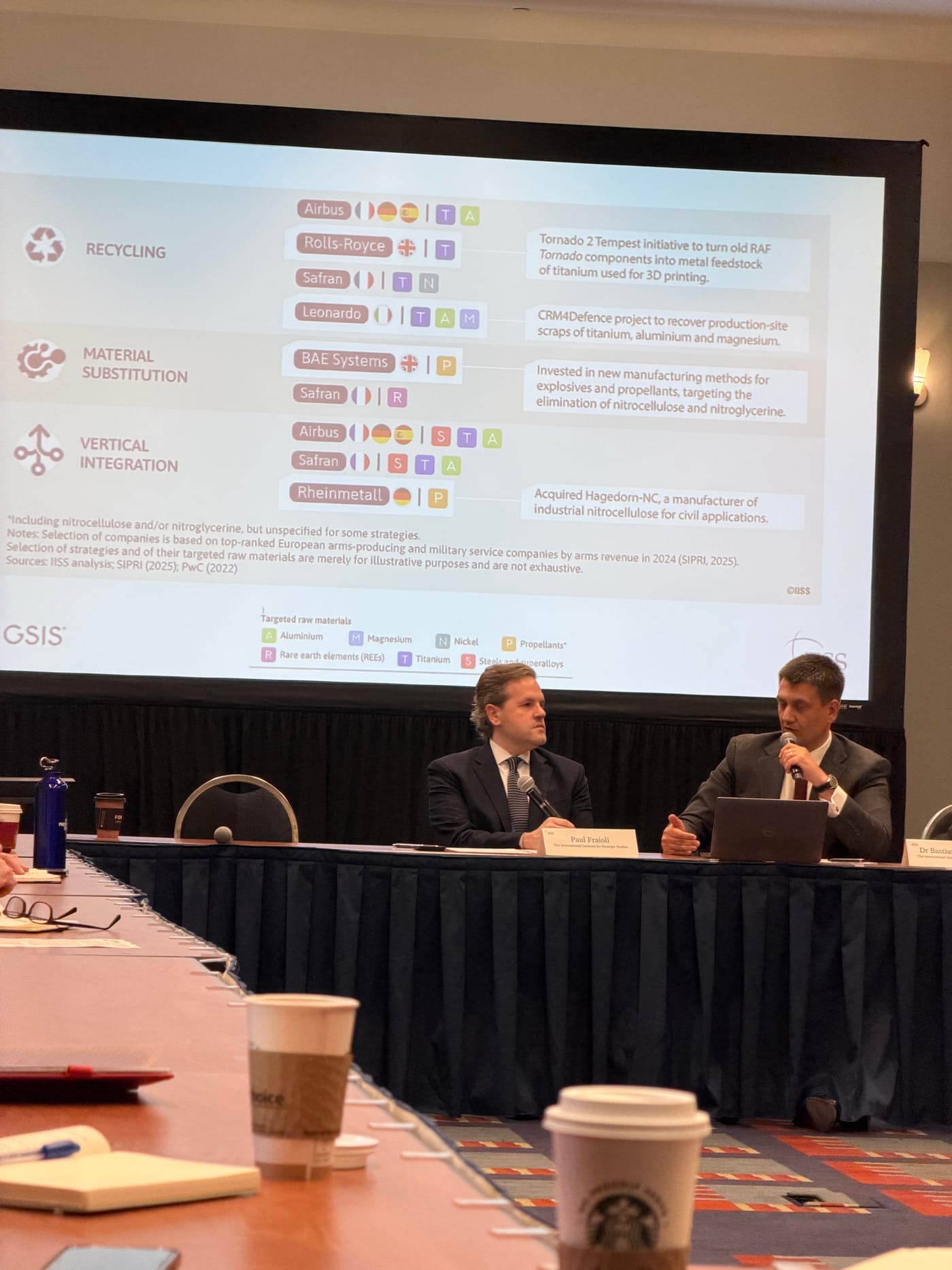
The geopolitical dimensions are real. Giegerich's presentation on European rearmament detailed how China's control over critical raw materials, rare earth elements, and processing capacity represents a growing vulnerability for European defense production, one that will become more acute as production scales up. A potential November 2026 deadline for Chinese export controls could apply restrictions to any goods with Chinese content, affecting European manufacturing broadly. "The real test will come as production scales up," he said. "Stockpiles can provide a short-term buffer, but resilience will require an industrial policy approach."
For organizations outside defense, the supply chain and semiconductor dynamics are worth watching. The chips that power AI systems, designed in the United States and manufactured primarily in Taiwan and South Korea, sit at the center of the most consequential technology supply chain on the planet. Export controls are already shaping who can access advanced AI computing power, and that is an active variable, not a stable backdrop.
What Is Happening at the Frontier
The conference offered a glimpse at AI applications that sound like science fiction but are operational today. What stood out as much as the breakthroughs themselves was a structural challenge shared by virtually every research organization we encountered: they are all producing more data than their existing systems can handle.
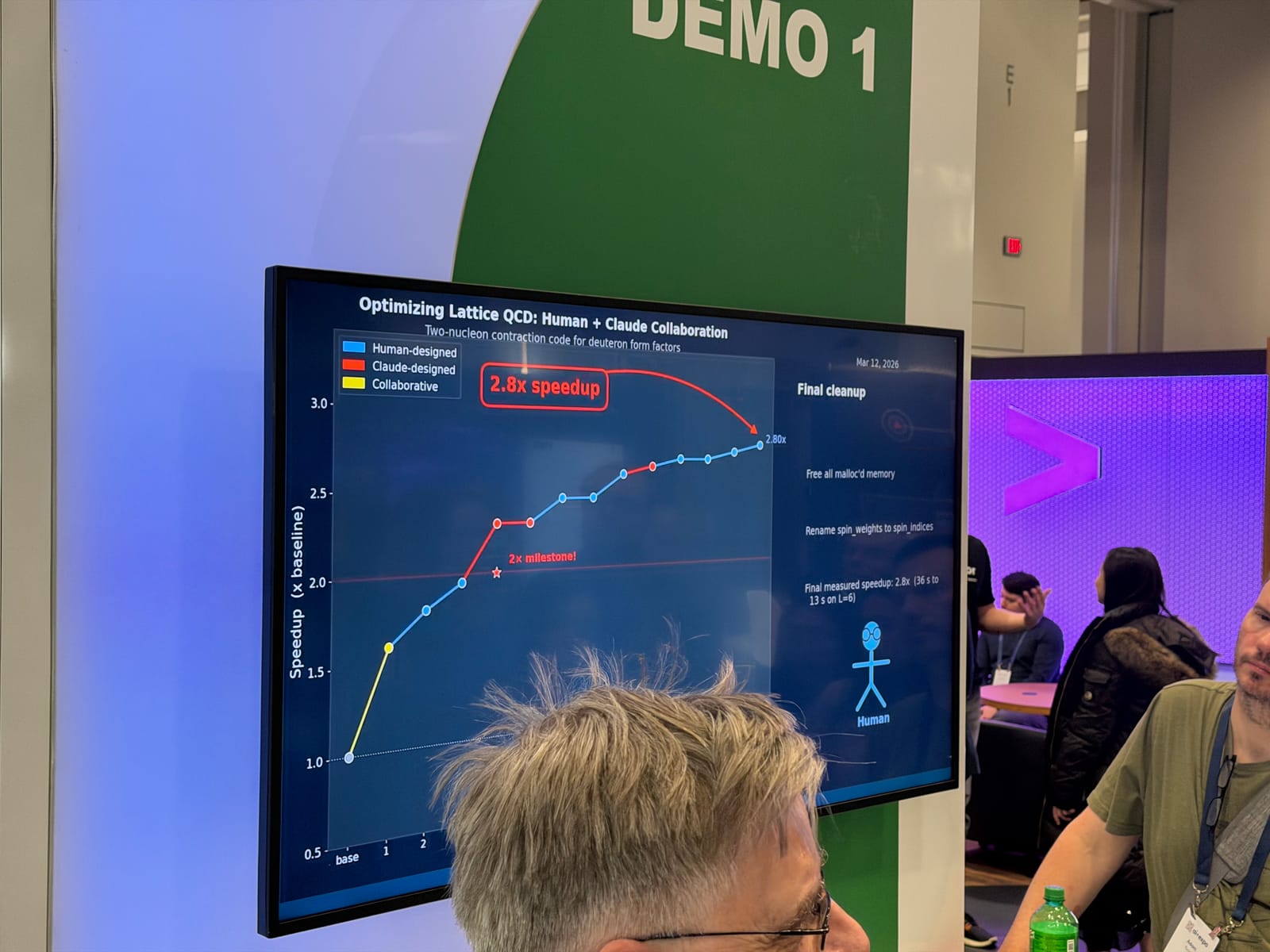
Dr. Charles E.A. Finney, Senior Research and Development Scientist at Oak Ridge National Laboratory, described a problem that will resonate with anyone who has managed complex workflows at scale. The supercomputer queues at national labs are so backlogged that researchers may wait weeks or months for a program to run, and by the time it does, they may have forgotten they submitted it. He also presented work by one of his graduate students using AI to optimize Lattice Quantum Chromodynamics (QCD), a branch of physics focused on understanding the forces inside atomic nuclei, achieving a 2.8x improvement in program efficiency. In this domain of research, that is an extraordinary result.
The U.S. Department of Energy (DOE) FemtoMind initiative is building on exactly this kind of work, applying AI across multiple national laboratories to accelerate quantum physics calculations that would otherwise take conventional computers years to complete.
Dr. Bobbie-Jo Webb-Robertson, Division Director and Chief Scientist at Pacific Northwest National Laboratory (PNNL), walked through her laboratory's use of AI in protein-based experiments spanning radiation, medicine, environmental science, and more. The science itself is remarkable, but she was candid about the organizational challenge underneath it: a significant amount of opportunity is being lost simply because of the volume of data produced and how dispersed programs are across the institution. After completing more than 50 AI projects, her team keeps returning to the same question: "So you have a model. Now what?"
This is not unique to national laboratories. We heard the same theme from conversations with representatives from the University of Chicago and Colorado State University. In every case, the pattern is the same: world-class organizations using AI in genuinely impressive ways, producing results faster and at scales that were previously impossible, but layering those capabilities on top of existing data infrastructure that was never designed to handle the volume, variety, or velocity of what AI now generates. The bottleneck is not ambition. It is architecture.
Moderna co-founder Noubar Afeyan presented on AI's role in compressing drug discovery timelines that once stretched across decades. Dr. Eric Xing, President of the MBZUAI (Mohamed bin Zayed University of Artificial Intelligence) in Abu Dhabi, grounded all of it in global context: AI research leadership is no longer concentrated in a handful of American universities and technology companies. It is distributed globally, and the institutions investing most aggressively now will shape what is possible for everyone in the decade ahead.
A New Kind of Warfare and What It Signals for Influence

One of the most thought-provoking sessions at the conference addressed a dimension of AI that rarely surfaces in enterprise conversations: cognitive warfare.
Dr. Anshu Roy described how AI is now being used not just to process battlefield intelligence but to understand and influence how adversaries think. Rhombus Power's systems have been used operationally in support of India during military operations and actively in Ukraine for the past eight months, combining predictive intelligence with real-time awareness of the information domain.
“Warfare in the physical domain, whether kinetic or non-kinetic, and warfare in the information domain, both of them combine together with neurological science to give you what one now calls cognitive warfare.”
The relevance for non-defense organizations is not about warfare specifically. It is about the growing sophistication of AI's ability to analyze how information spreads, who amplifies it, and what resonates with specific audiences. Organizations that understand this dynamic, regardless of sector, will be better positioned than those that do not.
Robots: Impressive, Imperfect, and Moving Fast
No recap of the AI+ Expo would be complete without acknowledging the robots, because they offered the most honest, unscripted illustration of where the technology actually stands today.
On the expo floor, RoboJo's automated barista kiosk served attendees throughout the conference. It made drinks in under 60 seconds, operated mostly without staff, and offered over 250 combinations. It also got roughly two out of every three drinks wrong, and at the Wednesday evening reception at the Waldorf, it produced one of the most aggressively unpleasant margaritas we have ever encountered. Nobody was particularly upset. Everyone found it oddly charming. That reaction, in itself, says something about where expectations currently sit for AI-powered hardware.
The contrast with IntBot's humanoid robot Nylo was striking. Positioned as a conference receptionist, Nylo handled attendee questions fluidly and naturally. At one point, an attendee asked it to respond in Albanian, and it did so without hesitation in fluent, conversational Albanian. IntBot builds what it describes as "social intelligence for physical AI," meaning systems designed to understand human intent, context, and social cues in real-world environments. Nylo has previously been deployed at NVIDIA GTC and San Jose International Airport, communicating in over 50 languages. On every dimension that matters for that use case, it delivered.
The two interactions together tell the real story of where AI-powered robotics stands in 2026. Some applications, particularly those involving language, social interaction, and information delivery, are genuinely ready. Others are still finding their footing. The gap is closing faster than most people expect, but it has not closed yet.
For a more industrial data point, Lockheed Martin's F-35 production line now uses AI-trained models combined with physical cameras and robotics for foreign object detection, catching defects that human inspectors routinely miss. That is not a demo. It is a production system running on one of the most scrutinized manufacturing programs in the world. The throughline across all of it is that AI combined with physical systems is no longer a future concept. It is deployed, imperfect, advancing, and already redefining what machines can do alongside people.
What to Take Away from All of This
If you are a business leader, an institutional decision-maker, a policymaker, or simply someone trying to understand what the noise around AI actually means for your organization, here is what we would suggest taking from what we heard.
Start with the workflow, not the technology. The organizations getting real results from AI are not the ones that bought the best tools. They are the ones that first identified the decision or process they needed to improve, then built AI around it. Deploying AI into a broken workflow makes broken workflows faster. Redesigning the workflow first changes the outcome entirely. This is where AtomDigit always begins.
Build your data foundation before you scale your AI. The single most consistent finding across every sector at this conference was that AI layered on top of fragmented, inaccessible, or poorly structured data will not produce reliable results. It will produce faster noise. Addressing data architecture before scaling AI applications is not a delay. It is the work that makes everything else sustainable. AtomDigit treats data readiness as a prerequisite, not an afterthought.
Compliance cannot be retrofitted. Organizations deploying AI in regulated environments, including government contractors, financial services firms, healthcare providers, and universities, are building accountability gaps that will surface at the worst possible time. Security and governance architecture needs to be designed into AI systems from the start. AtomDigit's three-layer security framework, covering government requirements, client security posture, and forward-looking recommendations, is built into every engagement from discovery through deployment.
AI-native structure outperforms AI-retrofitted structure. The clearest differentiator between organizations making meaningful progress and those spinning in place was not budget or technical capability. It was whether they had redesigned their operations around AI or simply layered AI onto what already existed. The former compounds advantages over time. The latter produces diminishing returns. AtomDigit is built from the ground up to help organizations make that structural shift.
The global pace is accelerating, and the standards are being set now. Governments, militaries, and major institutions worldwide are not evaluating AI. They are deploying it, at scale, with urgency. The compliance frameworks, security standards, and operational expectations being established today will define what every organization is expected to demonstrate in the years ahead. Organizations that move now with a sound approach will be defining those standards. Those that wait will be catching up to them.
The AI+ Expo was a reminder that AI is no longer an emerging technology. It is an operational reality for a growing number of organizations across every sector and every part of the world. The question is not whether it will affect how your industry works. The question is whether your organization is building the foundation to benefit from it, or playing catch-up later.
At AtomDigit, that is the work we do every day. Not building demos. Building systems that actually work, inside real organizations, within real constraints.
If any of the challenges described here resonate with what your organization is navigating, we would be glad to talk.
